Timestamp disagreement is one of the easiest ways to misdiagnose a data-transfer problem. But fixing the clock does not guarantee that the transferred feature means the same thing.
The offset
During the provider-transfer audit, the best common alignment was a shift of −180 minutes. Once this shift was applied, the price series aligned strongly enough for the clock layer to pass.
Separate the layers
The audit deliberately avoided a single aggregate “parity” score. Instead it separated:
| Layer | Question | Outcome |
|---|---|---|
| Clock | Are equivalent observations compared at equivalent market times? | PASS |
| Price | Does the liquid-market price structure transfer after alignment? | Strong alignment |
| Spread features | Do derived microstructure features preserve structure? | Not proven |
| Target scale | Can the historical target be adapted safely by scale mapping? | FAIL |
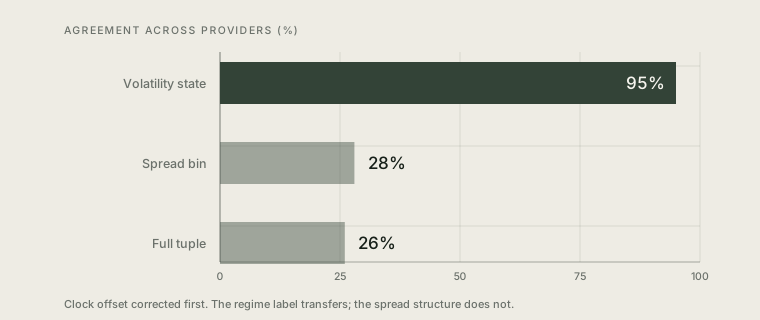
The clock problem was solvable without solving the feature-transfer problem. Roughly 95% volatility-state agreement coexisted with only about 28% spread-bin agreement after alignment. The full combined tuple agreed on roughly 26% of observations.
Why this matters
A three-hour clock error can create false mismatches. Correcting it removes one confounder. If the feature still fails after the correction, the remaining disagreement becomes more informative-not less.
This is particularly important for provider-sensitive variables. Two feeds can represent nearly the same market price while exposing different spread dynamics due to aggregation, account type, symbol configuration, liquidity or vendor methodology.
Operational policy
The research consequence was fail-closed: alignment success was not allowed to promote the spread model into prospective provider use. Feature transfer had to be established separately.
Limitations
- The −180 minute shift is an empirical result for the compared datasets, not a universal conversion rule.
- The audit does not identify a single causal reason for every spread mismatch.
- No claim is made that provider-specific spread behavior is inherently worse; only that equivalence was not demonstrated.